The power and pain of stories: the hero’s journey and therapy
(Originally published by Counselling Directory, March 2026)
We are stories, miraculous bundles of life unfolding through time and space. From the moment we begin to consciously perceive our surroundings, our tale begins: seeking shelter, comfort, affection or food, while resisting environments where these are absent.
As we grow, we learn, and the world begins to bristle with possibilities inspired by our culture. I remember wanting to be an astronaut, then a scientist, at an age when the future felt boundless and uncomplicated.
Another thing happens as we grow. Like Cinderella discovering there was a time limit that would abruptly end her evening, or Neo realising he is too far from a phone booth as Agents circle him within The Matrix, we discover the rules of our world – and they are unique for each of us.
As children, we don’t question these rules or conditions; we simply accept that to receive the love we need to feel safe, there are certain things we must do: behave, be on time, not cry, get good grades, finish our dinner, be quiet, not eat too much, not complain, and go to bed without protest.
The early patterns that shape us
The thing is, we don’t naturally grow out of these conditions. As we move forward in our own stories, they become part of us, echoes of our early need to please following us into friendships, relationships and work. The perfectionist, the person who always says yes, the overachiever – these are often manifestations of our need for acceptance and love, as we continue to follow patterns learned perhaps decades earlier. In my own therapy journey, I know I did.
But while we are stories, we are incomplete ones. We are not novels or films with elegantly tied beginnings, middles and ends. We can find ourselves midway through our narrative, wondering: how did I get here? Where am I going? Confused because we are not where we once hoped we would be.
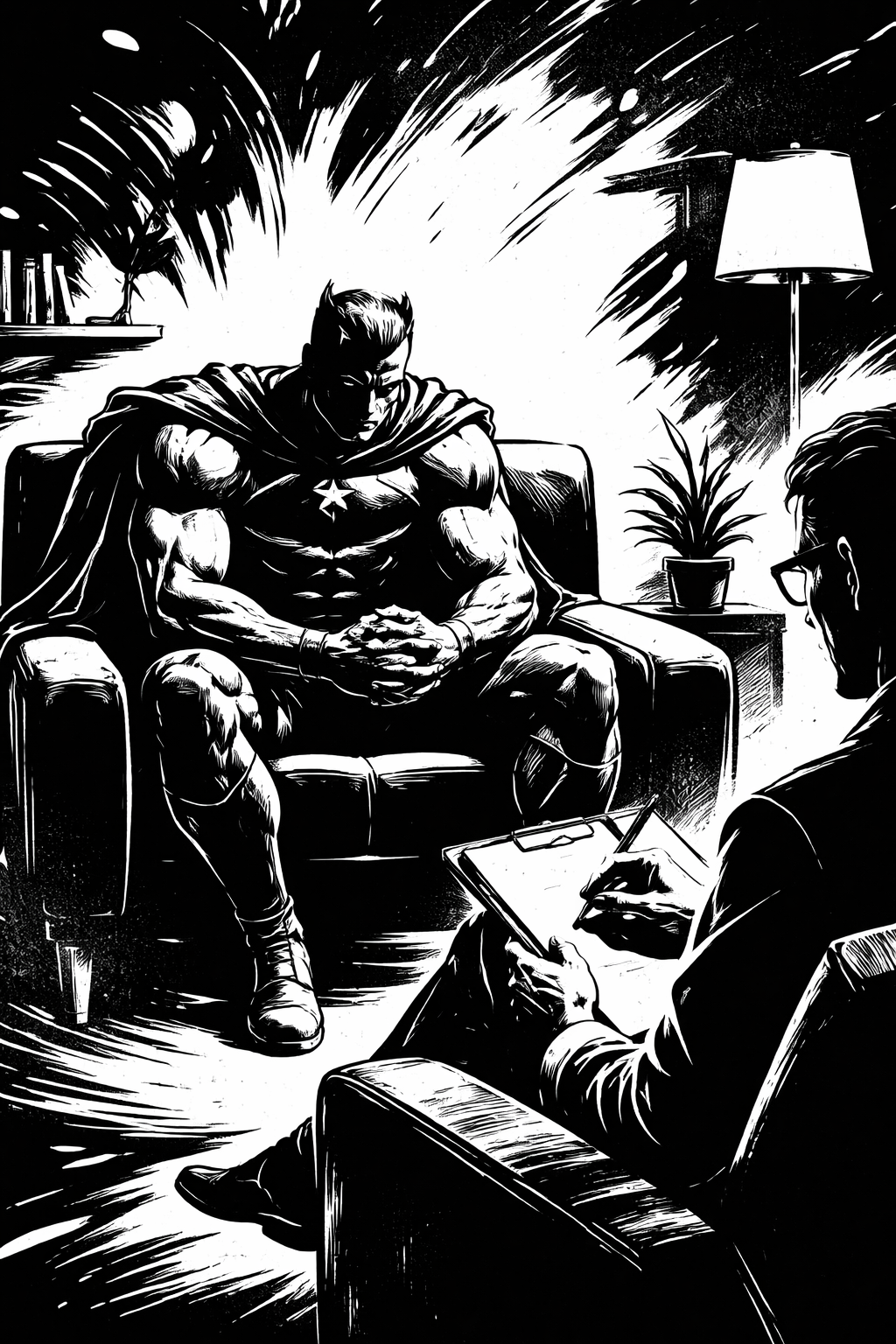
A hero finds themself questioning their life choices
The hero’s journey
The shape of those seemingly perfect stories was identified and articulated in The Hero with a Thousand Faces by Joseph Campbell. Campbell explored myths and religious stories across cultures and history, describing what he called the “monomyth”: a universal pattern in which a hero, often reluctantly, embarks on a journey, encounters trials and ordeals, and returns changed.
It is striking that across our evolution and cultural development, this structure has persisted – from caves to multiplexes. It is as if the stories we tell each other, whether born of fantasy or forged from collective memory, are as central to our identity as DNA is to our biology.
But living in a world shaped by the monomyth has consequences. From Toy Story to Star Wars, we absorb these narratives and weave them into our own expectations, aspiring – consciously or not – to find our version of a triumphant arc.
When your story no longer fits
“And I’m not sure I want to be me anymore.” (Theodore Twombly, Her). It’s a quiet line, but it captures something profound: the moment a person recognises that the story they have been living no longer fits.
People often find themselves drawn to therapy when life feels too hard, incomplete, confusing or just somehow wrong. Carl Rogers spoke of incongruence – the experience of being at odds with oneself. A person may sense that something in their life is misaligned, that their narrative has drifted off course, yet have no clear sense of where it shifted or how to redirect it.
This tension often arises from a mismatch between who a person believes themselves to be and the feelings and needs they actually experience. That believed identity is frequently shaped by the early conditions we internalised. As we grow and mature – embarking on relationships, careers and responsibilities – those inherited rules meet the complexity of adult life. A person may believe themselves to be a patient partner, for example, yet feel angry and underappreciated. Unable to voice this directly – because it threatens their image of themselves – they might become irritable at work instead, affecting performance and opportunity.
Therapy as a companion
In some ways, the therapist becomes a willing companion through the ordeal of the client’s story, travelling together across tricky terrain and emotionally turbulent landscapes – not to slay a dragon, but to turn towards it. As a client’s sense of who they really are gradually – or sometimes suddenly – aligns more closely with their lived experience, they move towards greater congruence.
When a person’s sense of self matches how they actually feel and experience the world, life often simplifies. Actions are no longer driven primarily by the need to impress or secure validation, but by a felt sense of rightness. There is greater clarity about who they are and where they wish to go – and why. Rather than feeling powerless, at the mercy of some unseen script, they begin to write their own.
Healing is not about reaching a final chapter. There are no perfectly tied endings like those in books and films. It is about becoming the author rather than the character swept along by someone else’s script – reclaiming agency in the here and now as we move toward an ending that may be unknown, but is at least truly ours.